
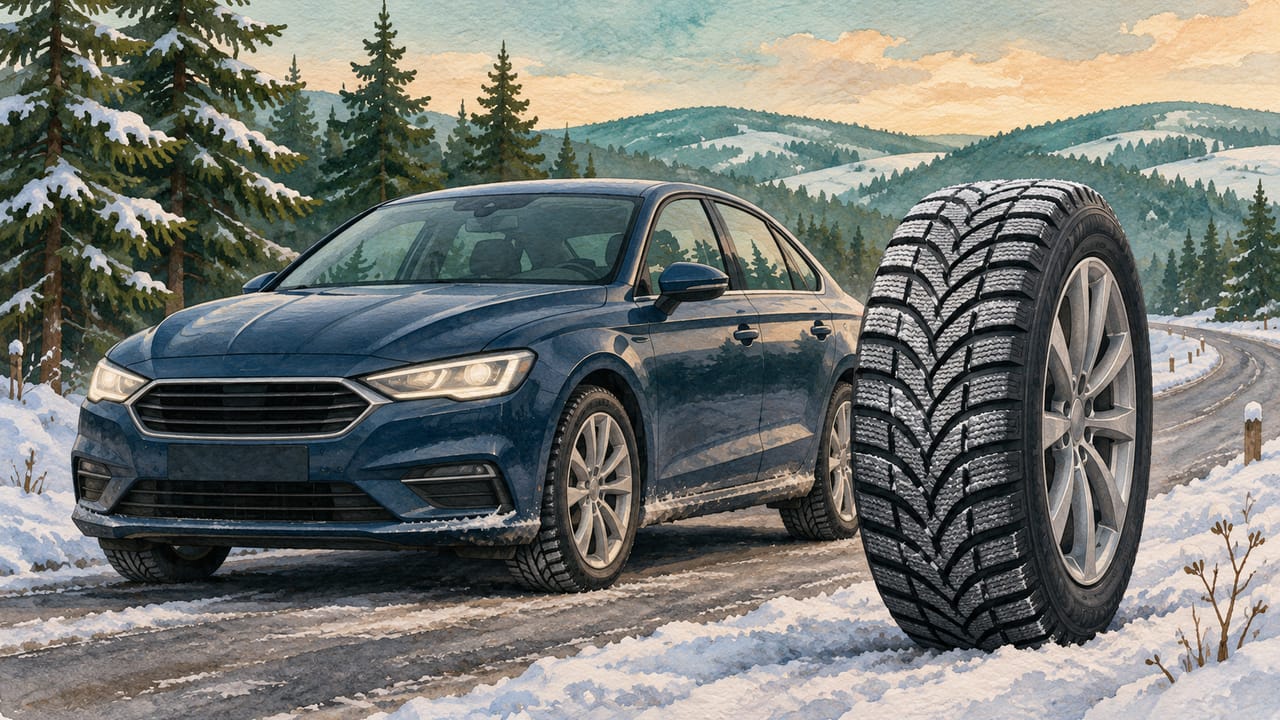
Your winter tire decision depends on more than your ZIP code. Snow depth, road clearing, your schedule and the tires already on your car all matter. Here is how to choose a suitable setup and prepare it for the season.
Start with the roads you actually use
A winter tire is a seasonal choice, not a requirement for every driver. Consider the weather on your normal routes, how quickly roads are cleared, and whether you can delay a trip during a storm. NHTSA says winter tires are more effective than all-season tires in deep snow.
For example, imagine two drivers in the same town. One commutes before snowplows arrive. The other can work from home during storms. Their location is identical, but their exposure and need for a dedicated winter set differ.
Understand the sidewall markings
Look at the letters and symbols molded into the tire sidewall. They describe different things. Ask the seller to identify the markings on the exact tire you are considering.
| Marking | What it tells you |
|---|---|
| M+S, M/S or M&S | A mud-and-snow designation found on many all-season tires. It is not the same marking as the mountain and snowflake. |
| Three-peak mountain and snowflake | A severe-snow marking. It identifies a tire that meets a specified snow-traction test, not a promise of grip on every icy surface. |
A tire manufacturer’s guidance describes the two markings and recommends four winter tires for optimal winter performance. Read the guidance. Some all-weather tires also carry the mountain-and-snowflake symbol. Check the actual tire, rather than relying on a product name.
Road restrictions can depend on the state, route and conditions. Before a mountain trip, check the responsible transportation agency for current tire or chain requirements. A marking alone does not guarantee that a tire satisfies every local restriction.
Choose a compatible set of four
Check the owner’s manual and the vehicle’s tire information label before shopping. Compare the recommended size, load index and speed rating with the proposed tire. The U.S. Tire Manufacturers Association advises using the recommended specifications and consulting a tire professional when you have questions.
Budget for four winter tires, not just the driven wheels. Matching winter traction across the vehicle supports more predictable handling. A tire professional can check vehicle-specific requirements and explain any exceptions. Keep the other set labeled and store it as the tire maker recommends.
Check tread and condition
A winter label cannot restore worn tread. Inspect all four tires for uneven wear, cuts, bulges and other damage. Use a tread-depth gauge in several grooves and locations. If you find damage or uneven wear, ask a tire professional to inspect the tire and the vehicle.
NHTSA recommends at least 2/32 inch of tread on all tires. Its penny test places Lincoln’s head upside down in a groove. If the top of his head is visible, the tire needs replacement. That minimum is not a guarantee of useful snow traction. Discuss replacement before winter if tread is approaching it.
Set pressure when tires are cold
Cold weather can reduce tire pressure. Use a gauge when the tires are cold, which NHTSA defines as at least three hours since driving. Check the recommended pressure on the driver-side door label or in the owner’s manual. Front and rear recommendations can differ. See NHTSA’s winter guidance.
Find the vehicle recommendation
Use the pressure for your vehicle and its stated loading conditions.
Measure each cold tire
Remove the valve cap and press the gauge onto the valve. Compare the reading with the recommended pressure.
Adjust and recheck
Add or release air as needed. Replace the valve cap. Check the spare if your vehicle has one and the manual calls for it.
Do not use the maximum pressure printed on the tire sidewall as the vehicle’s recommended setting. Do not intentionally underinflate for snow. The tire manufacturers’ association warns that underinflation makes tires more vulnerable to damage. Check pressure regularly and after a major temperature change.
Plan the trip as well as the tires
Winter tires do not eliminate the need to adjust your driving. Slow down, increase following distance and allow more time to stop. NHTSA notes that slick roads make a vehicle harder to control or stop. Read its winter driving advice.
All-wheel or four-wheel drive can help a vehicle move, but it does not remove the need for stopping distance. The tire industry association cautions that four-wheel drive does not by itself improve stopping or prevent skids. Check forecasts and road conditions before departure, and postpone the trip when conditions exceed your ability or equipment.
If your route requires chains or another traction device, check your owner’s manual for compatible equipment and installation points. Practice installation before the trip. Seasonal tire changes also deserve a plan: ask your tire professional when to switch back for the conditions where you drive.
Source notes
Sources checked November 2, 2026: NHTSA TireWise; NHTSA winter driving tips; U.S. Tire Manufacturers Association seasonal tire care; USTMA tire replacement guidance; and Michelin tire-mixing guidance hosted by NHTSA. Local restrictions and vehicle manuals may specify additional requirements.
Frequently asked questions
Do I need winter tires if I have all-wheel drive?
All-wheel drive can help a vehicle move in snow, but it does not replace tire grip or shorten stopping distance by itself. Consider the conditions you drive in and whether you can avoid storms.
Are all-season tires the same as winter tires?
No. All-season tires handle a variety of conditions and have some snow capability. NHTSA says winter tires are more effective in deep snow. Check the exact tire’s markings and the conditions it is designed for.
Can I install just two winter tires?
Plan for a matched set of four. Mixing seasonal tires can change handling. Ask a tire professional to check your vehicle maker’s requirements before replacing or mixing tires.
Does the mountain-and-snowflake symbol guarantee safety on ice?
No. The symbol indicates that a tire meets a specified snow-traction test. Ice, tread condition, speed and road conditions still affect grip.